James City County vs Williamsburg: Which Lifestyle Fits?
April 9, 2026
April 9, 2026
Trying to decide between James City County and Williamsburg? It is a common question for buyers who want the right fit, not just the right address. If you are weighing space, convenience, housing style, and day-to-day feel, the differences between these two areas can matter more than price alone. This guide will help you compare the lifestyle tradeoffs so you can move forward with more confidence. Let’s dive in.
The clearest difference between James City County and Williamsburg is scale. According to U.S. Census QuickFacts, James City County has 82,797 people spread across 142.30 square miles, while Williamsburg has 16,030 people across 8.94 square miles.
That gap shapes how each place feels. Williamsburg is much more compact, with roughly 1,793 people per square mile, while James City County is closer to 582 people per square mile. In practical terms, the city often feels more close-in and centrally organized, while the county tends to feel more spread out and suburban.
Your daily routine can look different depending on which area you choose. Census data shows James City County has a 76.7% owner-occupied housing rate, compared with 53.2% in Williamsburg, based on current housing and commuting data.
The same source shows James City County has 31,990 households with 2.49 persons per household, while Williamsburg has 5,020 households with 2.19 persons per household. That points to a more owner-heavy, residential pattern in the county and a smaller-household, more mixed housing pattern in the city.
Commute time is another useful clue. James City County’s mean travel time to work is 26.6 minutes, while Williamsburg’s is 19.5 minutes. If you want a more car-oriented rhythm with room to spread out, the county may line up better with your goals. If you prefer a more compact setup, the city may feel easier to navigate day to day.
For many buyers, housing stock and lot size are the deciding factors. James City County has a much more suburban housing profile, while Williamsburg offers a broader mix of compact housing types.
The county’s housing chapter shows how much it has grown over time. James City County went from about 5,000 residential units in 1970 to about 32,838 residential units in 2018, reflecting a long shift from rural to more suburban development.
That same report notes that single-family units, attached and detached, make up 77.5% of the county’s housing stock. It also says 36.5% of homes were built after 2000, which helps explain why many buyers experience the county as newer and more single-family oriented.
Lot size flexibility is also wider in the county. County zoning materials show examples ranging from 10,000-square-foot minimums in some residential districts to 3-acre minimums in rural residential areas and 20-acre minimums for residential uses in agricultural districts, according to county ordinance materials.
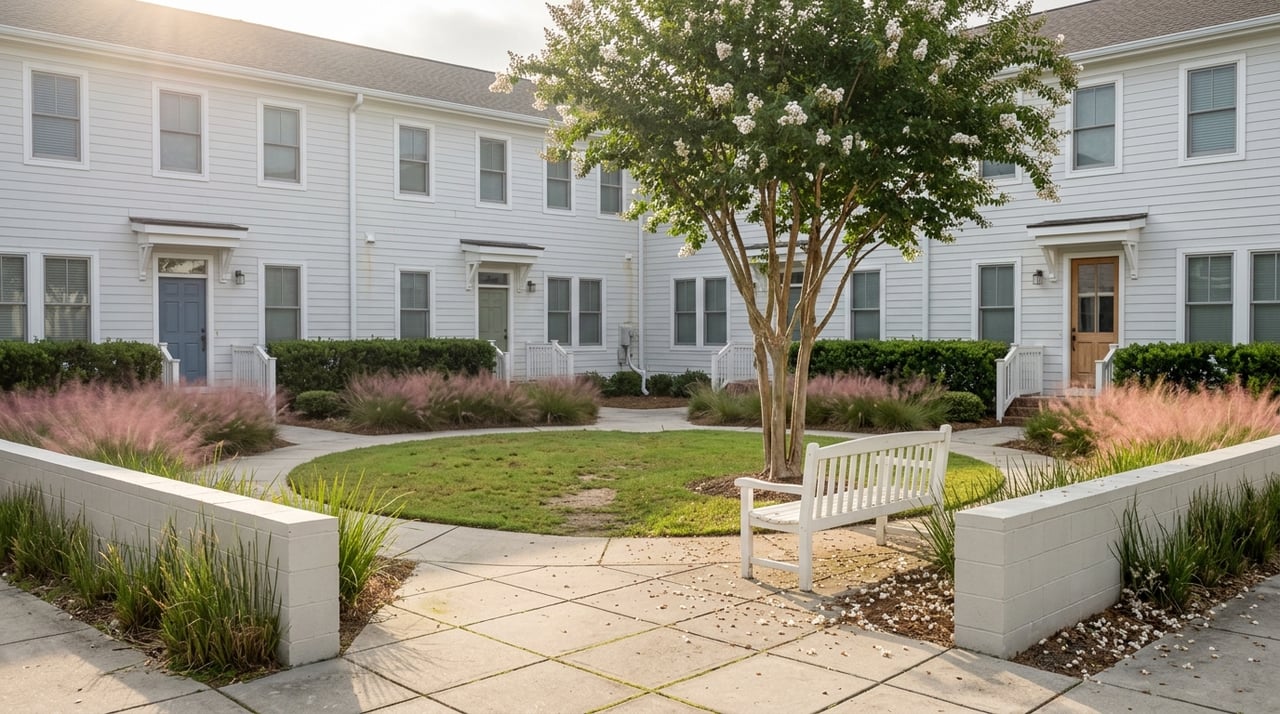
Williamsburg’s land-use plan points to a more compact development pattern. Low-density single-family detached areas generally range from 10,000 to 20,000 square feet, while medium-density detached areas generally range from 5,000 to 7,000 square feet.
The city also includes planning categories for duplexes, townhomes, apartments, downtown residential, and urban residential areas. That gives you a wider mix of housing forms if you are open to a smaller footprint or want a more connected setting.
Williamsburg’s planning also reflects its tighter land constraints. The city says 60% of its land is in a Resource Management Area or Resource Protection Area under the Chesapeake Bay Ordinance, and only 6% is in Downtown and Midtown Planning Areas where greater residential density is allowed. That helps explain why the city feels more compact and more urban in character.
Housing is only part of the decision. The overall feel of each place is shaped by history, institutions, parks, and how land is used.
Williamsburg has a strong identity tied to history and major institutions. The city’s official About page says it is home to William & Mary, the second oldest college in the U.S., and the Colonial Williamsburg Foundation, described as the world’s largest living history museum.
Those institutions shape the city in visible ways. The same page says William & Mary owns about 22.6% of the city’s land area, while Colonial Williamsburg owns about 25.8%. That helps create a place that often feels historic, campus-adjacent, and more concentrated.
The city also has a more established urban neighborhood pattern. Williamsburg’s rental inspection program applies to four districts with higher numbers of rental units and older housing that may need additional maintenance attention. For buyers, that points to a housing mix with more turnover and a stronger presence of older structures.
James City County puts a strong focus on open space, trails, and natural assets. The county’s Natural & Cultural Assets Plan says protecting natural lands and open spaces ranked as the highest priority in the Engage 2045 process.
That priority shows up in the county’s recreation system. James City County Parks & Recreation says the county offers more than 3,000 programs each year, 17 parks, 1,711 acres of park land, and 2 recreation centers. If your ideal routine includes more room, more green space, and amenities spread across a larger area, that may be a strong match.
Williamsburg also offers outdoor access, just in a different format. The city says it owns and maintains 10 parks, with amenities that are more concentrated and close-in than the county’s wider park system.
If you are deciding between James City County and Williamsburg, it helps to think in terms of lifestyle first and price second. Median owner-occupied home values are fairly close at $447,200 in James City County and $428,100 in Williamsburg, according to Census QuickFacts. That means the bigger differences usually come down to housing form, lot size, density, and daily rhythm.
If you are still unsure, start with the way you want to live. Ask yourself whether you picture more yard space and a suburban footprint, or a more compact home with a historic and centrally connected feel.
From there, look at home type, lot size, and commute patterns before focusing too much on headline pricing. That approach usually leads to a clearer decision and a home search that feels much more targeted.
If you want help comparing homes, neighborhoods, and lifestyle fit across Hampton Roads, Kristie Weaver can guide you through the options with a clear strategy and responsive support.
Stay up to date on the latest real estate trends.

Get assistance in determining current property value, crafting a competitive offer, writing and negotiating a contract, and much more. Contact me today.